

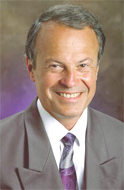
to go to Richard's
Article Index.
Sport
in Society
is proud to support

Dick
Schaap: Reflections on a National Treasure
by Richard E. Lapchick
I first met Dick Schaap in 1977 at the US Open in Forest Hills, NY. Our group was outside protesting the presence of South African tennis players in the US Open. It was the first protest in the long struggle to stop American sports contacts with teams representing the apartheid nation.
Dick was covering the event and came over to tell me that Arthur Ashe was going to speak to the protestors. Arthur had been an advocate of going to South Africa to build bridges and, by example, showing the people of South Africa why blacks and whites should play together. We feared that Arthur would announce that we were wrong to advocate a boycott. As the top African-American tennis player in the United States, that would have seriously dampened the impact of our protest against sports contacts with South Africa.
Dick leaned toward my ear and said, "I think that you will be surprised by what Arthur will say." Indeed, I was. Arthur came out and took a stand against sports contacts with South Africa. He said that his approach had failed and the only way to affect change in South Africa was to isolate them.
Dick interviewed me afterwards asking what I thought. I knew that having Arthur on our side would make a tremendous difference in the anti-apartheid movement and it did.
Over the years, Dick covered several events that I was involved in including other anti-apartheid protests such as the announcement of a possible boycott of the Los Angeles Olympics if the South African Davis Cup Team was allowed to play here in 1978. Dick covered the launching of both Northeastern University�s Center for the Study of Sport in Society and the National Consortium for Academics and Sport.
Each time Dick came I could tell that he had thoroughly studied what he was about to cover and he was prepared with penetrating questions in a disarming spirit that made me confident that his coverage was going to be fair. It was Dick�s way. He made us think about ourselves, what we were doing and what impact it would be having on the world. He would never do a puff piece in his coverage on us. The questions he asked and the way he asked them challenged us to be sure we were doing things in the right way.
By the mid-1980�s, Dick and I had become friends and he was one of the strongest advocates for Sport in Society and the Consortium. In 1986, Sport in Society gave our second Award for Excellence in Sports Journalism to Dick.
Several years later Northeastern University President Jack Curry announced that the University was going to give Dick an Honorary Degree and have him be our commencement speaker. President Curry was a great sports fan and enjoyed being able to pay tribute to the people involved in the world of sports for their accomplishments off the playing as much as for what they did on the playing field. I could sense from some faculty members that they were uncomfortable with this as it did not fit the academic image of the university. There was that same sense when Dick took the podium to address those at the commencement ceremony.
However, Dick�s marvelous use of language, humor and references to literature brought the faculty to its feet at the conclusion of his remarks. I never saw that happen before or since at any of the commencements that I have attended at Northeastern over the years. We asked Dick to be the master of ceremonies for our awards banquet. He did that for 12 consecutive years at our ceremonies in Boston.
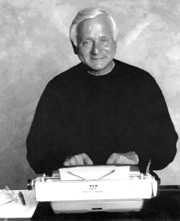
After the Consortium opened its own separate office in Orlando in 1997, he hosted its event as well. Over the years, not only did he do this without a fee but he never even let us pay his expenses. He began to bring his wife Trish to the events because he felt a special kinship to Northeastern and the extraordinary but lesser known people we have honored. We try to acknowledge the selfless acts of people involved in the world of sport who try to make society more compassionate, safer and healthier.
When we created a Hall of Fame in 1994 and inducted Muhammad Ali as the first honoree, Dick announced that "this was my favorite Hall of Fame because it honors just one person, the man who is truly the greatest."
In subsequent years, we inducted Arthur Ashe, Bill Russell, Wilma Rudolph, Jackie Robinson, "Red" Auerbach and Rafer Johnson.
This year Dick was going to be the first Journalist to be inducted into our Hall of Fame. Who else could it have been?
The day before Dick went in for hip surgery in September, he called to say how much he was looking forward to being more mobile and to get back to the game of golf that he loved so much without pain. When I heard the news from Trish several days later that the surgery had not gone well, my wife, Ann, and I waited, hoped and prayed that Dick would recover quickly so that we could honor him.
The gods decided that this would not be the case and took Dick from us on December 21, 2001.
We will be honoring Dick posthumously as we did for Arthur, Jackie, and Wilma. He will be in good company but he always was. People joke that Dick was a name dropper but he actually simply new almost everybody who was a good person in the world of sports and beyond. Walking through hotels, on streets and on our campus I saw a side of Dick that those who got to spend personal time with him all knew. It did not matter whether you were a celebrity, a star athlete or someone he had never met before who was selling bagels on campus, sweeping the streets or making his hotel room bed.
Dick Schaap treated everyone with love and respect. That is the way we will always remember him � with love and respect.
The first time he MC�d our banquet in Boston, Dick introduced me as "the Jiminy Cricket of sport." My knowledge of children�s literature had then become obscured by the fact that my two older children were teenagers. When I got back to the table and I said to my wife Ann, "what did he mean by that?" Ann said that Jiminy Cricket was Pinocchio�s conscience. Then I understood and smiled.Dick introduced me as "the Jiminy Cricket of sport" for the next 11 years.
However, the reality was that if sport had has a Jiminy Cricket, it was Dick Schaap. He made us reflect on that we could do better to serve humanity while making us smile about that which we already did.
Like so many others, I miss him tremendously but know his spirit will always live in the hearts of those fortunate enough to have known him as a friend.
Northeastern
University's
CENTER FOR THE STUDY OF SPORT IN SOCIETY
360 Huntington Avenue, Suite 161 CP
Boston, MA 02115-5000
Phone: (617) 373-4025
Fax: (617) 373-4566 / 2092
E-MAIL US at [email protected]