
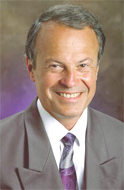
RICHARD
E. LAPCHICK
Founder / Director (Emeritus)
As Director Emeritus of Sport in Society, I will:
- Have
a significant responsibility with the Development Council, working with
Allyce Najimy and the new Director, to
establish goals and targets.
- Plan
to meet key funders at least once a year to demonstrate the Center's
appreciation for their support.
- Support
for the annual banquet through personal letters and phone calls.
- Shepherd
a partnership with Scholastic through to its completion as the violence
prevention curriculum most widely available in every high school in
the U.S.
- Work
to keep the Center's links with the NHL, WNBA, Major League Soccer,
NBA, NFL, the NCAA, ESPN, Sports Illustrated and The Sporting News as
vibrant as ever.
- Be present at key Center events such as Project TEAMWORK's Human Rights Squad Forum, the MVP Institute, NSAD and, of course, the Awards Banquet.
The vision of the Center will continue to be:
- Building
current programs.
- Spreading
the curriculum of Project TEAMWORK and MVP across the nation.
- Increasing
research projects on social issues in collaborative efforts with prominent
scholars.
- Increasing advocacy and work on issues of equity.
RICHARD
LAPCHICK
ARTICLE INDEX
Dear friends, I write to you this year at a momentous time in the history of the Center. If someone asked me when I became Director of the Center 17 years ago what the future would hold I would never have imagined that sports would grow so much in popularity, that our children's needs would develop into life and death issues, and that the programs created by Sports in Society would be so successful in working with a growing sports world and meeting the needs of our children.
Writing this Message From the Director column will be the last time I do so as the Director of the Center. However, my passion for working with the Center, my love for Northeastern University and my devotion to the staff of the Center make me extremely grateful that I will become Director Emeritus of Sport in Society as of August 2001.
I am excited about the new challenges I will have as the holder of DeVos Eminent Scholar Chair and as Director of College of Business Administration at the University of Central Florida (UCF). The DeVos Program will use the values of Sport in Society along with the NCAS as the philosophical underpinning of the new program.
My pride swells when I look at our accomplishments. Normally I use this letter to discuss the success of the individual programs in the past 12 months. However, because of this moment what I would like to do is review our accomplishments over the life of the Center.
Project TEAMWORK was called "America's most successful violence prevention program" by public opinion analyst Lou Harris after he evaluated the program in 1993. In 1995, the Bill Clinton Administration declared Project TEAMWORK a model for conflict resolution. It was also honored with the 1993 Peter F. Drucker Award as the most innovative non-profit program in the social sector. A new Harris evaluation in May 2000 concluded that Project TEAMWORK was even more effective now and determined it to be "absolutely essential in the struggle to reduce violence in our schools."
Since 1993, the MVP program has motivated more than 24,000 male and female student leaders in 72 high schools and middle schools in Massachusetts and at 80 plus colleges and universities to work together to solve problems that have been historically considered "women's issues" such as rape, battering and sexual assault. As of the year 1999-2000, there has not been a single act of a male student-athlete committing an act of violence against a female on any of those campuses since MVP trained there. Since 1998, MVP has annually trained the New England Patriots coaches and rookies. Due to its success, the United States Marine Corps contracted with the Center to provide MVP to its non-commissioned officers worldwide.
In five years, Athletes in Service to America, which combines Project TEAMWORK and MVP at five sites around the nation, has enrolled over 400 corps members and provided over 400,000 hours of community service. AmeriCorps CEO Harris Wofford said, "Athletes in Service is a star program that needs to be spread." Eli Segal, former AmeriCorps CEO and founder, has said, "Athletes in Service to America is the best of the best of AmeriCorps programs."
Social and economic barriers prevent urban youth from participating in 85 percent of youth sports programs as compared to youth in suburban communities. The focus of Urban Youth Sports is to create both non-traditional and traditional sports opportunities for children in Boston while teaching life-skills to participants to help insure their success in the classroom and in life as adults. UYS has become a national model.
On the same national scale, when we started the National Consortium for Academics and Sports (NCAS) in 1985, there were five colleges that we knew of that allowed their student-athletes to get aid for a fifth year after their eligibility had expired. It was against NCAA rules to grant a sixth year of aid. Now almost all Division I colleges give 5th year aid. The NCAA made 6th year aid permissible if the school is in the NCAS. More than 20,000 former student-athletes have continued in NCAS programs alone. The schools have put up more than $147 million in tuition support. The NCAA started its own degree completion program which has assisted another 1,500 students to complete their education. When we started there were two colleges that we knew of that had their student-athletes doing community service. We started that very idea through the NCAS. Now almost every college in the land has some form of community service. More than 8.1 million young people have been reached and have received 8.3 million hours of service in NCAS member programs.
As college and high school sport became more about business and entertainment, the student-athlete was becoming more and more of a commodity and simply an athlete. The media regularly said the term "student-athlete" was an oxymoron. We started National Student-Athlete Day (NSAD) in April of 1987 to counter this trend with 30 events around the country. In April 2001, 311,000 high school student-athletes were acknowledged for academic achievement and community involvement! The NCAA and its high school equivalent, the National Federation of State High School Associations, now co-sponsor NSAD.
Not one US college had done diversity training in athletics before we brought our Teamwork Leadership Institute (TLI) to the University of Maryland in 1990. Now we have done it on 75 plus campuses and the NCAA offers diversity training as part of its outreach programs. No one was assessing how athletic departments fit in with the overall mission of the university until the College Student-Athlete Project (CSAP) did that with 23 campuses in three years under a United States Department of Education grant. Shortly after the launch of the CSAP, the NCAA launched its certification program which has proven so valuable to our campuses over the last decade. No sports organization banned athletes involved in violence against a woman until the Center formed such a policy adopted by the NCAS in 1997.
Northeastern University put together the first group of colleges that took a stand against sweatshop labor, which became the vanguard among colleges pressuring companies to stop such sweatshop practices. The Racial and Gender Report Card is, of course, unique. The disparities it documented and publicized has led to many leagues, teams and athletic departments embracing diversity management training in response while making their hiring practices more inclusive.
As I change roles, I am fully confident that Allyce Najimy, our new Senior Associate Director, will guide us with her strength, creativity and determination in the years ahead in conjunction with whoever is chosen as our new Director. I leave confident that the vision for the Center that we all helped create will remain intact.
That vision includes:
- Building current programs.
- Spreading the curriculum of Project TEAMWORK and MVP across the nation.
- Increasing research projects on social issues in collaborative efforts with prominent scholars.
- Increasing advocacy and work on issues of equity.
I am so proud to have worked with so many great leaders at the Center and the NCAS for 17 years. I will still be part of both organizations in addition to my new role with the DeVos Program. I wanted the challenge of helping to create this new program because of the incredible importance it could have for the future of the business of sports. Currently there are more than 60 graduate programs in sports business management. None offer courses in diversity or community service and philanthropy. Both are important issues in the world of sport which is our nation�s most integrated work place. In addition, with the complexities of society and the world of sport, few offer courses on sport and social issues. UCF has pledged to make these the pillars of its curriculum which will also be based on the strong business offerings of the University in addition to sports-related business courses. RDV Sports made the program possible with a $2.5 million endowment matched by the State of Florida.
Sport in Society brings the values and programs that deliver help to our cities addressing the needs of children in crisis. The NCAS brings the network of 215 colleges and universities not only to deliver these programs nationally but also to bring future graduates into the DeVos Program.
My goal for the DeVos Program is that 10 years from now all sports business management programs across the country will recognize that the DeVos Program is not only the premiere graduate program addressing issues of sport business but also issues of sport in society.
My hope is that they will adopt similar curriculum and values so that all people desiring to work in the business of sport will understand not only how to be profitable but also how sports can help build community and improve the lives in our communities.
As we begin a new era for Northeastern University's Center for the Study of Sport in Society, I thank all of those who have been with us from the very first days when Richard Astro, George Matthews, Jack Curry, and Scott Black got together to say that we can do something important.
For those who have joined us along the way, it has been a great journey that has only just begun for Sport in Society.
Northeastern
University's
CENTER FOR THE STUDY OF SPORT IN SOCIETY
360 Huntington Avenue, Suite 161 CP
Boston, MA 02115-5000
Phone: (617) 373-4025
Fax: (617) 373-4566 / 2092
E-MAIL US at [email protected]