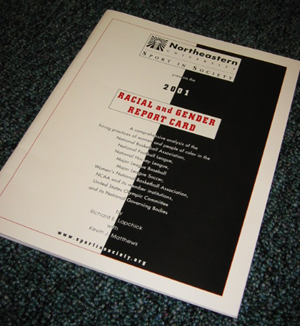
2001
Racial and Gender Report Card
|
RACE
|
GENDER
|
COMBINED
|
|
SPORT
|
GRADE
|
PTS
|
GRADE
|
PTS
|
GRADE
|
PTS
|
|
WNBA
|
A
|
92.5
|
A
|
93.3
|
A
|
92.9
|
|
NBA
|
A
|
90.8
|
B-
|
78.8
|
B+
|
84.8
|
|
NCAA
|
C+
|
76.5
|
C+
|
76.4
|
C+
|
76.5
|
|
USOC
|
C+
|
77.7
|
C
|
71.6
|
C+
|
74.7
|
|
MLB
|
B
|
83.5
|
D+
|
65.5
|
C+
|
74.5
|
|
NGB's
|
C+
|
78.1
|
C-
|
69.3
|
C
|
74.0
|
|
MLS
|
B+
|
86.0
|
D
|
61.0
|
C
|
73.5
|
|
NHL
|
C-
|
69.3
|
C+
|
77.0
|
C
|
73.2
|
|
NFL
|
B
|
82.7
|
D
|
60.8
|
C
|
71.8
|
 Summary
BOSTON
– Northeastern University's Center for the Study of
Sport in Society 2001 Racial & Gender Report Card (RGRC)
is a comprehensive
analysis the composition of players, coaches and key administrators
in the NBA, the NFL, Major League Baseball, the NHL, Major
League Soccer, the WNBA, the NCAA and its member institutions.
This
year's version of the Racial & Gender Report Card will,
for the first time, include the United States Olympic Committee
and its National Governing Bodies.
According to its findings, only the WNBA and the NBA are
close to genuine equity when it comes to opportunities for
women and people of color in professional and decision-making
positions in pro, Olympic and college sports. They had sports'
only A's in the category of race.
Grades
are based on racial and gender makeup of members of the
industry. In the 2001 Racial & Gender Report Card, when
grades for race and gender were combined, the WNBA (A) and
NBA (B+) were only leagues above mid-range C averages. No
category surveyed received less than a C for race. Only
the WNBA had an A for gender, contrasting with Major League
Baseball, the NFL and Major League Soccer, which all earned
D's in that category.
There
were also record numbers in both the NBA with ten (34 percent)
African-Americans as head coaches and in the 2001 Major
League Baseball season with six African-Americans and one
Latino manager (23 percent). In the NFL there are currently
three (ten percent) African-Americans in this post.
Despite
the widely held perception of the increases in African-Americans
in athletics, the data shows otherwise. The percentage of
African-American players decreased in Major League Soccer,
the WNBA and in college sports for men and women, and is
at a record 30-year low in Major League Baseball.
Since
its inception in 1984, the Sport in Society has attracted
national attention for its pioneering efforts to ensure
the education of athletes from junior high school through
the professional ranks. Its mission is to increase awareness
of sport and its relation to society, and to develop programs
that identify problems, offer solutions, and promote the
benefits of sport.
Statistical Highlights
- The
internationalization of American sport continues its dramatic
rise with an all-time high of international athletes in
the NBA (11 percent), the NHL (30 percent), Major League
Soccer (25 percent), Major League Baseball (19 percent)
and in the WNBA (27 percent). This was also true in college
sport in general for all Division I for both men and women
- The
percentage of Latinos in Major League Baseball remains
at an all time high of 26 percent while continuing to
grow in both Major League Soccer and in Division I baseball
- The
WNBA has the best record for both people of color (45
percent) and women (85 percent) as professionals in the
league offices. Among the men's leagues, Major League
Soccer (26 percent) and the NBA (25 percent) have the
best records for people of color. Although the U.S. Olympic
Committee staff was well ranked in gender because of a
strong staff of professional women (43 percent), its National
Governing Bodies has the worst record for race;
- The
New York Islanders is the only professional sports team
that had people of color as majority owners. In the 2001
NHL season there were two Asian-Americans as co-owners
of the New York Islanders, Charles B. Wang and Sanjay
Kumar
-
There is still little racial diversity at the CEO position
in the five men's pro leagues. In all leagues combined,
there are only two African-Americans and two women who
hold this important position;
- There
are only 11 African-American general managers in the three
major men's professional sports; MLS had the only Latino
GM in the men's leagues; there are no female GMs in the
men's leagues
- The
percentage of women in professional positions declined
in the NBA, the MLB and MLS but increased in the WNBA,
the NFL, the NHL and the NCAA
- U.S.
colleges continue to provide the fewest opportunities
for people of color at the top management level. In Division
I, African-Americans make up only 2.4 percent of athletic
directors while women hold nine percent
- The
percentage of African-Americans coaching Division I men's
basketball increased to 21.6 percent while falling in
Division IA football to 4.7 percent, the lowest level
since the Racial and Gender Report Card first published
results for college sports
- The
trend of decreasing percentages of African-American players
in professional and college sport noted in the last Report
Card continued in some sports while being notably halted
in the NBA and NFL and in Division I Women's Basketball.
Quotes from the Authors
From
lead author Richard
Lapchick
Center
for the Study of Sport in Society
Founder (and now current Director Emeritus)
"As
in society itself, we have a long way to go to achieve equality
in sport. There was a decline
in the influence of women in most sports and organizations
covered. This makes it even more striking that the WNBA,
a women's league headed up by a woman, had the best record
for diversity in sport. The NBA has always had the best
record regarding diversity – its own creation is now
a worthy rival."
"There are now 20 head coaches
or managers of color in the NBA, NFL and Major League Baseball.
This is nearly 45 percent higher
than the previous best among the big three sports in past
reports. As our most visible off the field position, perhaps
this will lead the way to more breakthroughs in other areas
of our front offices and athletic departments."
From
co-author Kevin J. Matthews
Center
for the Study of Sport in Society
Director of External Affairs
"As
in previous reports, the 2001 data shows that professionals
and decision-makers in professional, college and Olympic
sports do not nearly reflect the number of players of color
competing in the game," Matthews said. "The
Center publishes the annual study to indicate areas of improvement,
stagnation and regression in the racial and gender composition
of professional, Olympic and college sports personnel and
to contribute to the improvement of integration in front
office college athletics department positions."
Media Information
Richard
E. Lapchick: 407-823-4887
[email protected]
Kevin
J. Matthews: 617-373-4256
[email protected]
|
|
|