1998
Racial Report Card
 Summary
BOSTON
– In
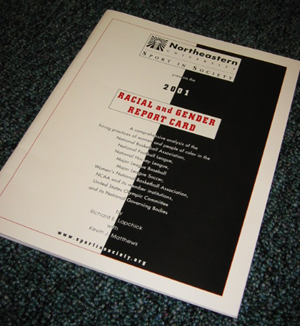
July of 1999, Northeastern University's Center
for the Study of Sport in Society released its tenth-annual
Report Card. The report analyzes the composition of players,
coaches and key administrators in the NBA, the NFL, Major
League Baseball, the NHL, Major League Soccer, the WNBA,
the ABL, and in college sport. The report, long known as
the Racial Report Card, has been renamed the Racial and
Gender Report Card.
Since
its inception in 1984, the Sport in Society has attracted
national attention for its pioneering efforts to ensure
the education of athletes from junior high school through
the professional ranks. Its mission is to increase awareness
of sport and its relation to society, and to develop programs
that identify problems, offer solutions, and promote the
benefits of sport.
Highlights
While the hiring practices in sport have gotten better
for people of color and women, there is clearly room for
progress in all sports. When looking at all the data, the
NBA continued to have the best record for diversity among
the professional sports leagues. Of the men's leagues covered
for the first time this year, Major League Soccer had the
best record for racial diversity and the NHL had the best
record for opportunities for women. The WNBA and the now
defunct ABL both had good records regarding both racial
and gender diversity. While the colleges and universities
improved, they continued to be behind the pros on diversity
issues.
The
Players
The extremely large number of international players
in the NHL, MLS, and the WNBA brought an added dimension
of diversity to these leagues. The number of international
players was also at a high point in the NBA and Major League
Baseball. The percentage of Black players decreased in all
men's professional sports as well as those playing at the
Division I collegiate level. On the other hand, in MLB the
percent of Latino players reached an all-time high of 25
percent. That was also true for all minorities combined
in Division I college sport which reached 32.1 percent of
all student-athletes. Women student-athletes in Division
I reached a new high of 39 percent.
The
Front Office
Another major finding was that for professional off
the field positions in both college and pro sports, the
growth of opportunities for women continued to exceed those
for people of color by significant numbers. However, many
of the jobs held by women indicated that there still is
a gendered division of labor in sports. Among the league
offices, the NBA had the highest percentage of people of
color (22 percent) and women (45 percent) in the three major
pro sports for professional positions.
Coaching
Positions
There were still no Black or Latino majority owners
in the NBA, NFL, the NHL, the WNBA, MLS, or MLB. There was
one Asian majority owner in MLS and in the NHL. Three women
were majority owners, two each in the NFL and one in MLB.
The current total of 12 minority head coaches and managers
in the three major men's pro sports leagues combined, was
down from 14 as in the previous report and still near the
low point of the decade. The NCAA Division I institutions
fared better in the sports in which minority student-athletes
had the highest rate of participation. However, overall,
of College Division I men's coaches (Historically Black
Colleges and Universities excluded,) 5.8 percent of the
head coaches were Black and 2.1 percent were other minorities
for a combined total of only 7.9 percent. The percentage
of women coaching women's teams was 43.7 percent, up slightly
from 42.9. In spite of some gains, colleges still had the
worst overall record for minorities holding head coaching
positions.
Team
Administration
Overall in all the pro leagues and college, there was
a decline in the number of people of color in the role of
the "principal in charge of day to day operations."
The percentage of Blacks in this key post in Division I
decreased from an already low 3.7 to 3.2 percent between
1995-96 and 1997-98. The ratio of women holding the position
of Athletic Director rose in Division I from 7.5 to 8.2
percent. Women and people of color reached all-time highs
in the senior administrative category resulting from slight
increases in the percentage of people of color holding such
posts in the NBA (14 percent) and the NFL (12 percent) while
there was a huge jump for women in both leagues. MLS had
the best record for minorities in the men's leagues in these
senior jobs at 20 percent. In the other professional administrative
positions, the NHL had the best record for women and MLS
had the best for minorities.
Media Information
Richard
E. Lapchick
407-823-4887
[email protected]
Kevin
J. Matthews
617-373-4256
[email protected]
|
|
|